Why pay for training?






Because employers do not hire vague potential alone — they hire usable skills.
Because many people discover that what they can do is not yet easy to prove.
Because employers often test what matters.
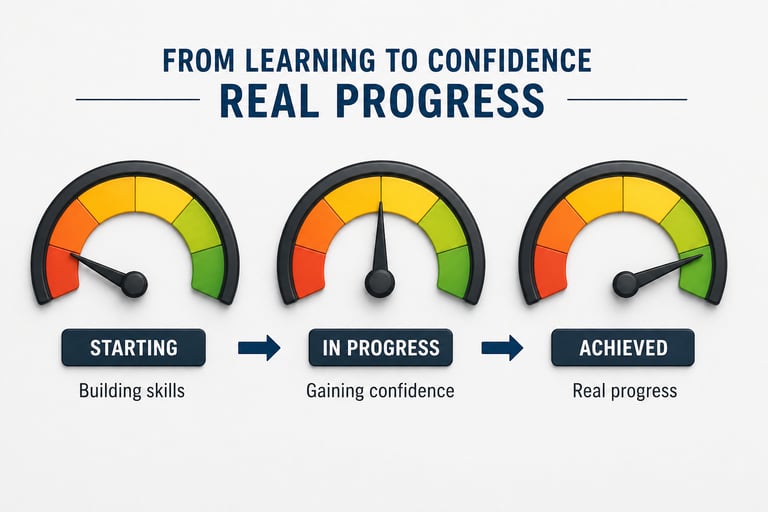


Because training improves actual performance and not just presentation.
Because confidence usually follows competence.


Because small differences in skill can make a big difference in employability.


Because recognised exams and third-party validation matter.


Because career change requires more than intention.


You may feel bright, capable and willing, but when you start applying for jobs, you'll soon realise that employers are looking for more than general potential. They are looking for evidence of skills that can be used in the role. Training helps to turn a vague claim into something more concrete, more credible and more job-relevant.
A lot of people have some knowledge but they can't yet present it in a convincing way. If someone says “I can use Word,” what does that really mean? Another person might say, “I know Excel,” but if they were asked at interview to sort data, use a formula, build a PivotTable, or explain how a VLOOKUP might help with a reporting task, they might struggle. You need to demonstrate your skills in a way employers recognise. Training helps close the gap between casual familiarity and practical competence.
Many employers do not just take a CV at face value. They test. That might mean a typing test, a practical Microsoft Office exercise, a bookkeeping assessment, or a technical support scenario.
This is why it's worth investing in training. You want to be ready when the test comes.
“I type” is not the same as saying, “I type accurately at 55 words per minute.”
“I have used Excel” is not the same as knowing you can use formulas, formatting, filters, VLOOKUP or PivotTables.
“I know bookkeeping” is not the same as saying “I understand double-entry bookkeeping and I am working towards, or have completed, AAT training.”
“I’m good with computers” is not the same as stating “I understand core IT support concepts and I am preparing for or have completed CompTIA-based training.”
Training helps turn loose experience into something more definite and demonstrable.
Employers do not hire vague potential alone — they hire usable skills.
Many people discover that what they can do is not yet easy to prove.
Because employers often test what matters.
Very often, the gap between getting rejected and getting shortlisted is not dramatic. It may simply be that one candidate can show a clearer, stronger and more specific skill set.
Imagine two applicants for an admin role.
One says: “I’ve done office work before.”
The other says: “I can type at 50 words per minute, use Word confidently for professional documents, and work efficiently in Outlook and Excel.”
Or two applicants for a bookkeeping role.
One says: “I know a bit about accounts.”
The other says: “I understand double-entry bookkeeping, bank reconciliation, journals, and I am studying AAT.”
Or two applicants for an IT support role.
One says: “I’m quite technical.”
The other says: “I understand core support and networking principles and I am working towards CompTIA.”
The second candidate sounds easier to hire because the employer can picture them doing the job.
Good training is not only about getting better at interviews. It is also about becoming more effective in real work.
That may mean learning the features in Microsoft Office that save time and improve quality. For example understanding how a PivotTable can summarise information quickly, or how Quick Parts and other tools in Outlook and Word can speed up routine admin tasks.
In touch typing, it may mean moving from “I can manage if I have to” to typing fluently enough that speed, accuracy and concentration improve together.
In bookkeeping, it may mean moving from a rough awareness of accounts to a proper understanding of ledgers, debits and credits, reconciliations, and accounting software, often supported by a recognised pathway such as AAT.
In IT, it may mean moving from general confidence around computers to a clearer grounding in practical support, troubleshooting and networking, often through a recognised route such as CompTIA.
Investing in training doesn't just make you sound better. It makes you better at doing the things that employers value.
A lot of people think they need confidence first. In reality, confidence often comes from knowing that, if asked, you can actually do the thing.
If someone says, “I type at 15 words per minute,” they may already know that this will hold them back in an office-based role. Training offers a route to improvement.
If someone says, “I know bookkeeping in theory, but I do not yet have AAT-level grounding or confidence with accounts software,” that uncertainty will often show in interview.
If someone says, “I know computers quite well, but I do not yet have a structured foundation such as CompTIA,” they may hesitate when pressed.
Training helps reduce that uncertainty. It give you a stronger base and that tends to show in interviews, assessments and workplace performance.
Small differences in skill can make a big difference in employability.
Training improves actual performance, not just presentation.
Because confidence usually follows competence.
This is especially true for people changing career. Wanting to move into administration, bookkeeping, IT support, legal support or another office-based field is one thing. Showing that you have begun to build the practical skills needed for that move is another.
Training helps make the career change look real. It shows commitment, direction and evidence of preparation. It shows you care about developing the right skills and are serious.
There is a real difference between saying “I think I can do this” and being able to point to structured training, exams or certification.
That might mean passing Pitman Training exams in practical office skills, working towards or completing AAT in bookkeeping and accounts, or studying CompTIA for IT support. Employers are often reassured by evidence that skills have been developed properly and, where relevant, checked by someone else.
This can be particularly useful if you've had repeated failed applications, especially without interview. In those cases, training can give you something clearer and stronger to present.
You're not paying simply for lessons. You're paying to become more employable, more credible and more effective.
Investing in training shifts the conversation.
“I’ve used Word before.” becomes “I can produce professional documents in Word and work efficiently with the tools employers expect.”
“I type, but slowly.” becomes “I can type quickly and accurately.”
“I know a bit of accounts.” changes to “I understand bookkeeping and am working towards, or have achieved, AAT-level skills.”
“I’m quite good with computers.” becomes “I have built structured IT knowledge through CompTIA-based study.”
Taking our courses means you can say “I have passed Pitman exams that show practical office skills.”
People pay for training as an investment in themselves. They want to get a job, or change career, and they know that clearer, stronger, more provable skills help them do that.
We have helped thousands of people to develop their skills and find new, better paying jobs. Get in touch with us to find out how we can help you do that too.
Recognised exams and third-party validation matter.
What am I paying for and what will I get?
Career change requires more than intention.
Contacts
enquiries@l3t.co.uk
Socials
Subscribe to our newsletter. We'll send you occasional emails and information on events, special offers and promotions.
+44 20 3307 6000